How Do You Know if You Can Trust Someone With Intellectual Property
Acquire how to protect your intellectual property rights—from copyrights to patents.

Intellectual belongings rights are the buying rights you have over things that yous create as a event of your original ideas. If your creation has economic value, you volition want to learn how to protect your intellectual property (IP) against any party that may try to use information technology for themselves.
Exactly how to protect intellectual property depends upon the nature of the intellectual holding. To help you larn more about IP protection and its diverse forms, this article volition cover:
- seven different intellectual holding rights
- 4 tips to protect intellectual property
- The basics of intellectual property enforcement
- How to fight theft of intellectual property
View the infographic below for a helpful summary of intellectual property protection and tips on guarding your creative ideas:

What Are the 7 Types of Intellectual Belongings Protections?
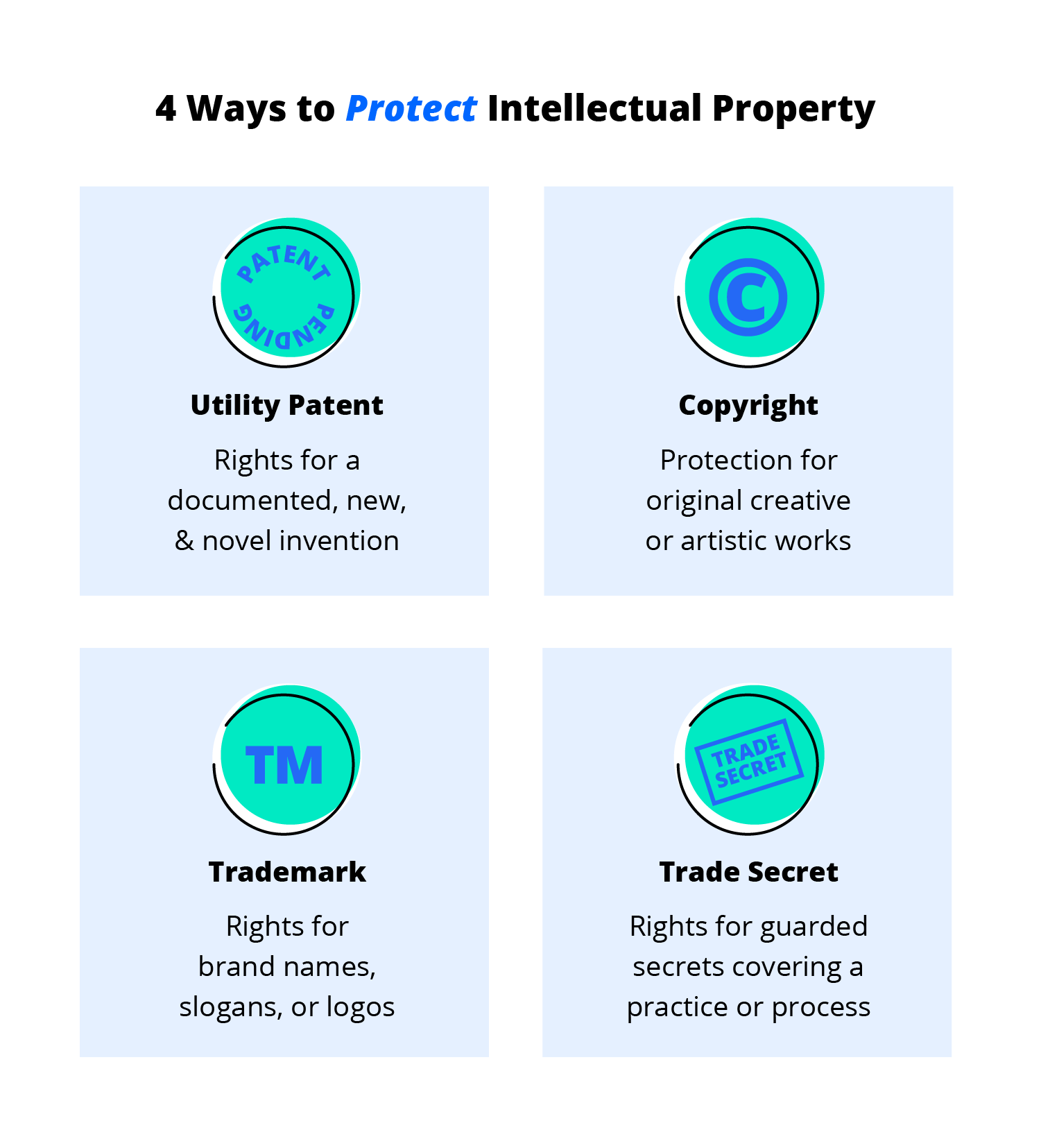
Copyrights, trademarks, patents, and trade secrets are the 4 primary types of intellectual belongings protection.
Determining the best way to protect intellectual property tin can be complex. This tin exist especially true in highly technical areas like industrial design or figurer algorithms.
- Instance:Someone who writes and markets new computer programs may need to copyright and patent the code and algorithms, likewise every bit register a trademark for marketing them.
Deciding on intellectual property protection takes conscientious consideration, so an intellectual holding attorney can ease your mind and assistance brand sure your property is fully protected.
1. Copyrights
Copyrights protect written and artistic works for the lifetime of the creator, plus 70 years.
These artistic works are the tangible representation of the creator's original ideas, since ideas themselves tin can't be protected. Copyrights can protect manuscripts, novels, song lyrics, paintings, photographs, sound recordings, and more than.
A copyright exists the moment the author creates the original work, but registration provides copyright owners with exclusive and enhanced rights. It tin can aid enforce their rights against infringement through litigation and allows owners to seek monetary amercement and attorneys fees if at that place is a lawsuit.
2. Trademarks
Trademarks can protect words, phrases, symbols, and logos that identifies one's appurtenances or services. A trademark registration tin last forever, as long as information technology'southward continued to be used in business, and is renewed every ten years. This makes the trademark i of the most crucial IP protections for businesses.
A business concern' intellectual belongings makes sure the business is reliably recognizable for patrons. This means that you won't exist able to trademark a logo that is similar to one of your competitors if it could cause confusion among consumers.
iii. Utility Patents
Utility patents protect inventions of dissimilar kinds for xx years. The key to a patent'due south protection is that the invention must be new or novel, meaning yous tin't patent something that already exists.
4. Trade Secrets
Trade secrets are a grade of intellectual property that your company may keep shut and cull not to share with others. This could be to protect an economic reward that might exist lost should your trade secret become public knowledge or exist stolen by a competitor.
Since they're not public and aren't filed with any official function, trade secrets offering no official protection for your intellectual property. But as long as y'all tin provide prove that you fabricated efforts to hold and protect the trade clandestine, any theft of it is punishable in courtroom. This punishment could be criminal, since corporate espionage (or intercompany theft of ideas) is a federal offense.
4 Tips for Protecting Intellectual Property
Protecting your intellectual property is a means to secure an economical reward for your business concern and brand sure you can defend your unique ideas, products, and services. The best way to protect IP is to register information technology with the government and enforce your ownership rights.
Beyond registration and enforcement, you can protect certain types of intellectual property past:
- Documenting your discoveries
- Using digital rights direction
- Opting for strong nondisclosure agreements
- Creating strong access credentials
Read on for more on these tips to proactively protect intellectual property earlier it'south stolen or repurposed.
one. Document Your Discoveries
In the Information Historic period, leaks are frequent. While you tin can't e'er baby-sit against them, y'all can record your discoveries and innovations equally they occur.
If another company obtains illicit information in a leak and attempts to repurpose or recreate your ideas, your records can put a date to your operations and testify your legitimacy (and your buying rights) over your intellectual property.
two. Use Digital Rights Management (DRM) Systems
If your work is published online and attainable to users, some of those users may try to copy your belongings. Digital rights management (DRM) protects your online assets with coding that does any, or multiple, of the following:
- Limits the number of times or the window of time a user can access your piece of work
- Restricts the number of devices your work can be accessed with
- Prevents users from editing, saving, or copying your piece of work
- Prohibits sharing, press, or taking a screenshot of your piece of work
- Watermarks your work to establish buying
DRM is a type of encryption that limits what a user can do with your protected piece of work. This option is a common choice for gated online content similar:
- Data studies and surveys
- Market place reports
- Eastward-books
- Software
With DRM, unauthorized use or reproduction of your online IP is much more difficult, if non impossible.
3. Opt for Strong Nondisclosure Agreements
A nondisclosure understanding (NDA) restricts whatever involved party from sharing information defined past the terms of the understanding.
Typhoon an NDA to strengthen your defenses against IPR violations similar trade surreptitious misappropriation, where an employee could share sensitive IP-related information with outsiders.
four. Create Strong Access Credentials
Guarding a hole-and-corner requires proactive action, unless you're the just person who knows the secret. Without adequate security around a trade hush-hush, courts won't be convinced that the secret was important enough to guard. Employ strong credentials to restrict admission to any valuable information, especially relating to intellectual belongings.
This might hateful:
- Separating teams so admission to files isn't shared
- Training employees on your company's security all-time practices
- Oftentimes updating passwords
As with any security protocols, leaks tin can notwithstanding happen. If your intellectual holding is compromised, it might be time to speak with an intellectual property skilful to decide your options for IPR enforcement.
How Does Intellectual Holding Enforcement Work?
When another party attempts to violate your IP rights, information technology'southward called infringement, or misappropriation when referring specifically to merchandise secrets. IP violations are ceremonious or criminal matters depending on the type of IP protection infringed upon and the severity of the violation.
Enforcing intellectual holding violations isn't e'er easy, only you tin can prepare yourself to fight violations with proper knowledge of how different violations are handled.
IP violations for the 4 main types of intellectual belongings protections vary. Mostly civil matters, they tin rise to criminal offenses if malicious intent or purposeful impairment is shown as a outcome of the infringement or misappropriation.
Patent Infringement
Getting a patent isn't every bit easy as filling out some paperwork. Patents are complex technical documents that require significant endeavor to typhoon and file.

As the inventor, it's your duty to evidence your case that your invention is new, novel, and worthy of protection. A patent clearly claims in precise language what you ain every bit the inventor, and is your proof of infringement in case a copycat shows upwards.
Copyright Infringement
Copyrights are a more abstract legal right than patent protections since they cover creative works like essays, drawings, and songs.

Copyright registration isn't required to obtain a copyright, only information technology can help you lot regain damages when defending your IP. A copyright is registered with the U.S. Copyright Office.
Trademark Infringement
Trademark protections don't just protect the name or pattern of your business or logo, they also protect what that name or logo represents.

Trademark litigation oft hinges on the likelihood of defoliation among customers equally to the source of goods or services.
Trade Hugger-mugger Misappropriation
Trade secrets aren't officially protected, merely this can often hateful that they're more than protected than other forms of intellectual property, because they're widely unknown and therefore can't exist copied.

To merits a compromised trade undercover, you must demonstrate that the clandestine is under lock and key—without legitimate protection, it's unlikely that a court volition back up your claim.
How to Fight Theft of Intellectual Holding
If a tertiary party steals your intellectual property rights, you need to have protections in place to fight the theft. If you lot haven't registered or protected your IP, yous may even so be able to halt the reproduction of your ideas, just you may not be entitled to any monetary amercement.
Y'all have two options to stop an IP violation in progress, but it'southward important to remember that registering your IP protections is your best run a risk of fighting whatever impersonator or infringers in courtroom.
1. Send a Request to Terminate the Violation
The first option to halt an IP infringement is to request that the violating action in question be stopped. This doesn't need to be a threatening asking but instead a warning notice. It states your ownership claim over the property in question and notes that you're requesting the recipient stop all actions related to the reproduction or usage of your intellectual property.
- Case: You lot own the publishing rights to a certain vocal that was recently featured in a YouTube video by a popular influencer. Yous may send a request for YouTube to remove the video to protect your IPR. The asking likely won't consequence in you being paid any monetary damages, but the influencer will be warned against committing similar offenses in the futurity.
2. Pursue Legal Action
If a cease and desist either doesn't work or isn't applicable to your IP violation claim, information technology may be time to pursue legal action against the infringer. You can't take this stride unless your work was previously registered and protected—if you determine to pursue legal activity, you'll demand to annals the work in question outset, and you won't exist able to recover any damages from the time before the piece of work was registered.
- Example:You ain a registered trademark that protects the branding and marketing for a popular board game. An online competitor creates a production that resembles yours and you believe it causes confusion for customers. You might file a civil case suing for an injunction to end the reproduction and sale of the competitor's product and for budgetary damages and losses.
IP protection prevents malicious actors (anyone who might effort to actively infringe your IP rights) and puts a cease to accidental misusage (anyone who may unintentionally borrow your IP rights). If your business organisation is intellectual property intensive, it's probable to be a target for others looking to make a quick profit by stealing your ideas.
Learn how to defend expressions of your ideas against theft by registering your intellectual property and speaking with an intellectual property attorney who can help ensure that the best possible protection is secured for your work.
Source: https://www.legalzoom.com/articles/how-to-protect-your-intellectual-property
Belum ada Komentar untuk "How Do You Know if You Can Trust Someone With Intellectual Property"
Posting Komentar