Difference Between an Adding Machine and a Calculator Hit the Plus Again

Calculators
by Chris Woodford. Last updated: Oct 12, 2021.
Can you lot think Avogadro's abiding to 6 decimal places? Tin can you effigy out the square root of 747 in less than a second? Can you lot add together up hundreds of numbers, 1 afterwards some other, without always making a mistake? Pocket calculators can exercise all these things and more using tiny electronic switches called transistors. Allow's have a peek inside a figurer and find out how it works!
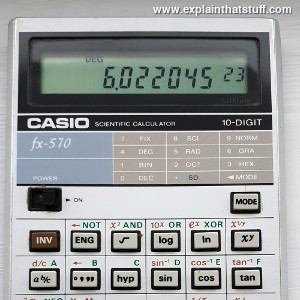
Photograph: This Casio fx-570 calculator has given me sterling service since 1984 and is still going strong today. In case you lot're wondering, Avogadro's constant (ane of many constants stored in this calculator and available at the touch of a push button) used to exist quoted as half dozen.022045 × 1023 (since 2011, newer sources have given a more than accurately calculated value of 6.022141 × 10²³).
Contents
- What is a calculator?
- What'south inside a figurer?
- How does the display piece of work?
- How does a calculator add two numbers together?
- Find out more
What is a calculator?
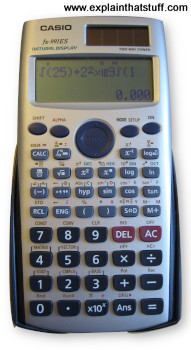
Photo: My newer Casio Computer, an fx-991ES, has a much larger "natural display" that can show entire equations and even perform calculus! The larger dark gray keys at the lesser are the numbers and the chief "operators" (+, −, ×, ÷, = etc). The lighter gray keys to a higher place them carry out a whole range of scientific calculations with a single button click. The brown-colored square in the extreme peak right is a solar cell that powers the car along with a small push button battery.
Our brains are amazingly versatile, but we find it difficult to calculate in our heads because they can store only so many numbers. According to a famous bit of 1950s inquiry by psychologist George Miller, we can remember typically v–9 digits (or, equally Miller put it: "the magical number 7, plus or minus 2") earlier our brains start to ache and forget. That'due south why people have been using aids to assistance them calculate since ancient times. Indeed, the word computer comes from the Latin calculare, which means to count up using stones.
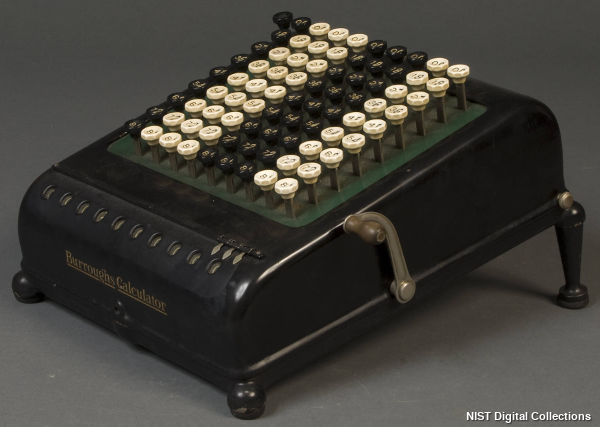
Photo: A Burroughs Mechanical reckoner from the early-20th century. Yous enter the numbers you want to work with using the nine columns of octagonal keys at the height, crank the handle, and read the result in the trivial "windows" at the bottom. Photograph courtesy of National Institute of Standards and Technology Digital Collections, Gaithersburg, Dr. 20899.
Mechanical calculators (ones made from gears and levers) were in widespread utilize from the late-19th to the belatedly-20th century. That'south when the first affordable, pocket, electronic calculators started to announced, thanks to the development of silicon microchips in the late 1960s and early 1970s.
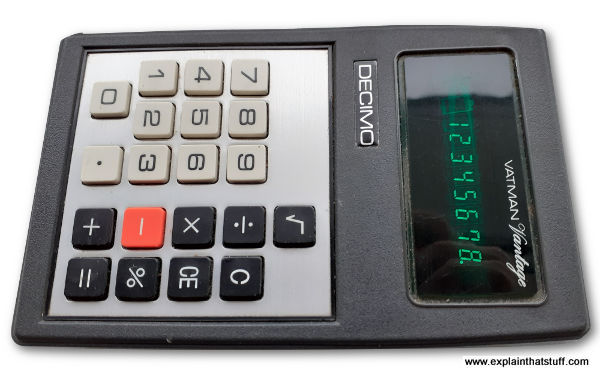
Photo: This is what calculators looked like in the 1970s. Note the very basic eight-digit green display (it'due south chosen a vacuum fluorescent display) and the relatively small number of mathematical functions (all you could really do was +, −, ×, ÷, foursquare roots, and percentages). What you can't see from this photo is how thick and mesomorphic this computer was and how big its batteries were. Mod calculators are far more advanced, much cheaper, and utilize a fraction as much battery power.
Mod calculators take much in common with computers: they share much of the same history and work in a like way, but in that location's 1 crucial difference: a figurer is an entirely man-operated machine for processing math, whereas a reckoner can be programmed to operate itself and practise a whole range of more than general-purpose jobs. In brusk, a computer is programmable and a calculator is not. (A programmable figurer sits somewhere between the two: you can programme it, but simply to do relatively simple mathematical calculations.)
What's within a calculator?
If you'd taken apart a 19th-century calculator, you'd have establish hundreds of parts inside: lots of precision gears, axles, rods, and levers, greased to high sky, and clicking and whirring away every time you lot keyed in a number. Simply accept apart a modern electronic calculator (I merely can't resist undoing a screw when I see one!) and y'all might be disappointed at how piddling you discover. I don't recommend you do this with your brand-new school calculator if you desire to stay on speaking terms with your parents, so I've saved you the carp. Here's what you'll detect inside:
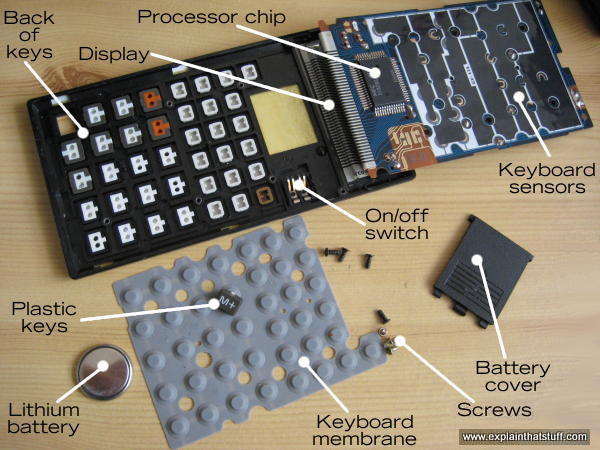
Caption: Inside the fx-570, which is face-down hither. We're effectively looking upwardly into the machine from below.
Don't worry, I managed to put it all dorsum together over again just fine!
- Input: Keyboard: About 40 tiny plastic keys with a safety membrane underneath and a touch-sensitive circuit underneath that.
- Processor: A microchip that does all the difficult work. This does the same job every bit all the hundreds of gears in an early on calculator.
- Output: A liquid crystal display (LCD) for showing you the numbers y'all blazon in and the results of your calculations.
- Ability source: A long-life battery (mine has a thin lithium "button" cell that lasts several years). Some calculators also have a solar cell to provide free power in the daylight.
And that's about information technology!
What happens when you press a key?
Printing down on 1 of the number keys on your calculator and a series of things volition happen in quick succession:
- As you press on the hard plastic, yous compress the rubber membrane underneath information technology. This is a kind of a miniature trampoline that has a pocket-size rubber button positioned direct underneath each key and a hollow infinite underneath that. When you press a key, y'all squash apartment the rubber button on the membrane directly underneath it.
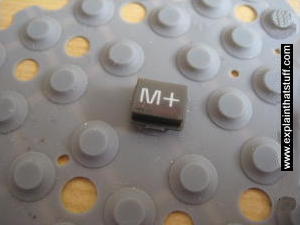
Photo: The keyboard membrane. I've left ane of the keys on the membrane to give you lot an idea of the scale. There'southward one rubber button straight beneath each cardinal. Read more in our article about computer keyboards. - The safe push button pushes down making an electrical contact between ii layers in the keyboard sensor underneath and the keyboard circuit detects this.
- The processor chip figures out which cardinal you take pressed.
- A circuit in the processor flake activates the advisable segments on the display corresponding to the number you've pressed.
- If you press more numbers, the processor chip will testify them upwardly on the display likewise—and it will go along doing this until y'all press one of the operations keys (such as +, −, ×, ÷) to make it do something different. Suppose yous press the + central. The computer will store the number you just entered in a small memory chosen a register. Then it volition wipe the display and await for you lot to enter some other number. As y'all enter this second number, the processor chip will display it digit-by-digit as before and store it in another register. Finally, when yous hit the = central, the calculator volition add the contents of the two registers together and display the event. In that location's a picayune more to it than that—and I'll go into a few more details down below.
How does the display work?

Artwork: A seven-segment display can show all the numbers from 0-9.
You're probably used to the thought that your figurer screen makes letters and numbers using a tiny grid of dots chosen pixels. Early computers used just a few pixels and looked very dotty and grainy, but a modern LCD screen uses millions of pixels and is almost every bit articulate and sharp equally a printed book. Calculators, however, remain stuck in the dark ages—or the early 1970s, to be precise. Look closely at the digits on a calculator and you'll see each one is fabricated from a unlike blueprint of 7 bars or segments. The processor scrap knows it tin brandish any of the numbers 0–9 past activating a dissimilar combination of these seven segments. It can't hands display letters, though some scientific calculators (more advanced electronic calculators with lots of built into mathematical and scientific formulae) do have a go.
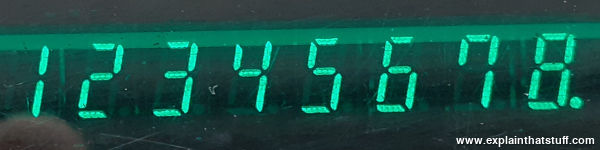
Photo: Await closely at the green digits on this display and you can meet that each one is made by lighting up 2 or more than of 7 segments. This is a closeup of the green vacuum fluorescent display in the 1970s estimator shown up above.
How does a computer add two numbers together?
So far we've had a very simple look at what's going on inside a computer, but nosotros've non actually got to the heart of how it takes two numbers and adds them to make a third one. For those of y'all who'd similar a bit more detail, here's a slightly more technical explanation of how that happens. In short, information technology involves representing the decimal numbers we use in a dissimilar format called binary and comparing them with electrical circuits known as logic gates.
Representing numbers in binary
Humans work on numbers in decimal format (the numbers 0–9) largely, information technology'south believed, because we have ten fingers and toes to count with. But the numbers we use to write out amounts of things are arbitrary. Let's say y'all have a pile of coins and y'all want to tell me how wealthy you are. You tin can signal to the pile, I can look at information technology, and if I see a lot of coins I'll conclude you're rich. But what if I'thousand not there to look at the pile? Then y'all tin can use a symbol to represent the coins—and that's what a number is: a symbol that indicates an amount. If there were nineteen coins, you lot could use the 2 symbols "1" and "9" written together: 19. Taken together, that means 1 × 10 plus 9 × ane = 19. That'due south how decimal works using a system of 10 symbols. But y'all could use other symbols too.
For the terminal century or and so, computers and calculators have been congenital from a variety of switching devices that can either exist in ane position or some other. Just like a light-switch, they're either "on" or "off." For that reason, computers and calculators shop and process numbers using what'south called binary code, which uses just two symbols (0 and 1) to stand for any number. So in binary code, the number 19 is written 10011, which means (1 × 16) + (0 × eight) + (0 × iv) + (one × two) + (1 × 1) = 19. The beauty of binary is that you tin can represent any decimal number with a series of switches that are either on or off—perfect for a calculator or a calculator—like this:
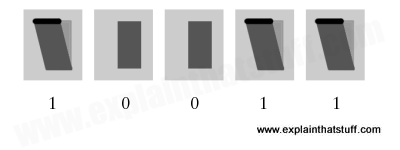
Artwork: How to represent the binary number 19 within a reckoner or a reckoner using 5 switches. Three are pressed down (switched on) and two are left as they are (switched off), indicating the binary number 10011, which is equal to xix in decimal.
Converting decimal to binary
The commencement thing your calculator has to do is convert the decimal numbers you input to binary numbers information technology can work with, and it does that using a (fairly) unproblematic circuit called a BCD (binary coded decimal) encoder. It's simpler than it sounds—and the blitheness below shows how information technology works for the numbers 1–9. At that place are 10 "input" keys (I've omitted zero) wired to four output lines. Each input is wired in such a way that it triggers one or more of the outputs, so the conversion procedure finer happens through the pattern of the wiring. For case, key one triggers just the line on the right, giving us an output of 0001 in binary, while key vii triggers three of the four lines giving the states 0111 in binary (4 + 2 + 1).
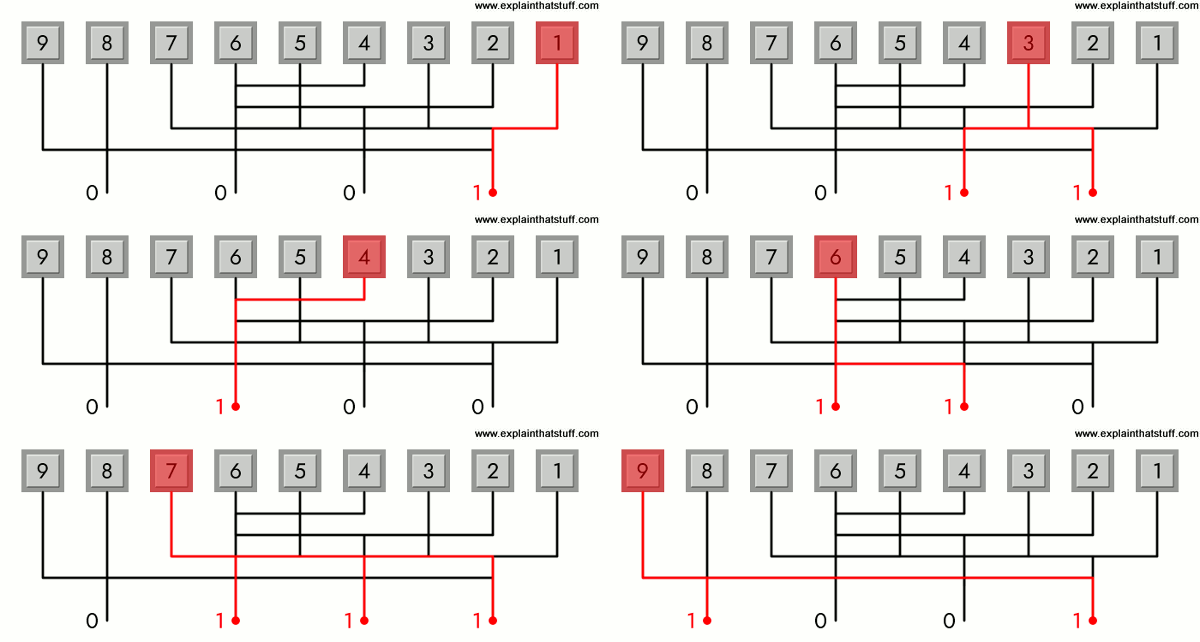
Animation: How a figurer's BCD encoder converts decimal input from the keyboard into binary output. The output lines are triggered by OR gates (described below) connected to the input lines, so each output line triggers if i OR more of the input lines connected to it send a current.
Using logic gates with binary
Let's say you want to do the sum iii + ii = v.
A reckoner tackles a problem like this by turning the ii numbers into binary, giving xi (which is three in binary = i × ii + one × 1) plus 10 (2 in binary = ane × two + 0 × i) makes 101 (5 in binary = one × iv + 0 × ii + i × ane). How does the calculator exercise the bodily sum? It uses logic gates to compare the pattern of switches that are active and come with a new design of switches instead.
A logic gate is really just a elementary electrical excursion that compares two numbers (inputs) and produces a third number (an output) depending on the values of the original numbers. In that location are four very common types of logic gates chosen OR, AND, Not, and XOR. An OR gate has two inputs (each of which can exist either 0 or 1) and it produces an output of 1 if either of the inputs (or both) is i; it produces a zero otherwise. An AND gate also has two inputs, but information technology produces an output of 1 only if both inputs are i. A NOT gate has a single input and reverses it to make an output. And so if you feed information technology a zero, information technology produces a 1 (and vice-versa). An XOR gate gives the same output every bit an OR gate, only (unlike an OR gate) switches off if both its inputs are ane.
Half adders and full adders
Now if you put unlike logic gates together, you tin make more complex circuits called adders. Y'all feed into these circuits two binary numbers equally their input and go out a third, binary number as your output. The number that comes out is the binary sum of the numbers yous put in. So if you fed in the electrical signals 10 and 11 yous would become out 101 (2 + 3 = 5). The basic ingredient of adder circuits is a pair of logic gates, working in parallel, called a one-half adder, which tin can do sums no more than complex than (look for it!) 1 + 1 = two. One example of a half adder looks like this:
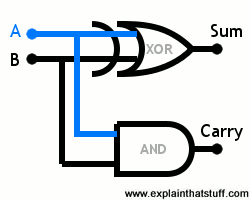
You feed in two binary numbers you want to add on the ii input lines A and B. They "travel" simultaneously to the inputs of the ii logic gates—an XOR gate at the top and an AND gate underneath. The output from the XOR gate gives the sum of the two inputs, while the output from the AND gate tells united states of america if we need to carry a ane. It'll be clearer what that means if we consider 4 possible calculations a half adder can do:
- If A and B both receive a zero, we're doing the sum 0 + 0 = 0. The XOR gate gives a nada if both its inputs are zippo, and then does the AND gate. So the effect of our sum is zero and the carry is null.
- If A receives a null and B receives a one, we're doing the sum 0 + 1 = i. The XOR gate gives a 1 if either i (but not both) of its inputs is a one. The AND gate gives a i simply if both of its inputs are one. So the effect of our sum is one and the carry is naught.
- If A receives a one and B receives a zero, it's just the aforementioned equally the previous example: the result of our sum is 1 and the carry is goose egg.
- Finally, if both A and B receive a one, we're doing the sum 1 + 1 = 2. Now the XOR gate gives a zero, while the AND gate gives a one. So the sum is nil and the comport is one, which means the overall result is ten in binary or 2 in decimal.
Half adders tin can't really practise whatsoever more than this, but if we put a few more logic gates together, we can brand what's called a full adder circuit that does harder sums with bigger numbers. How does an adder work? That's beyond the telescopic of this introductory article, but y'all can find a few examples on the web pages below.
Unless yous're doing a caste in electronics or computing, all you really demand to know is that an adder is built from a number of AND, OR, and Non logic gates contained inside chips that are connected together. Nosotros can utilize other patterns of logic gates to subtract, multiply (which tin also exist done by repeated improver), and practice other kinds of calculations.
Find out more than
- How logic gates add 2+3: A squeamish diagram of an adder circuit from ZByte. [Archived via the Wayback Machine.]
- Adder (electronics): A more complex, more comprehensive, just harder to understand article on Wikipedia.
Please note: No calculators were harmed during the making of this article.
Find out more
On this website
- History of computers (including the early history of calculating machines)
- How computers work
- Keyboards
- Logic gates
- Retentiveness
On other websites
- Vintage Calculators Web Museum: Corking photos and information almost early mechanical, electric, and electronic calculators, compiled by Nigel Tout.
- Elementary Computer Mathematics: Prof Kenneth Koehler explains the mathematics backside simple computer calculations.
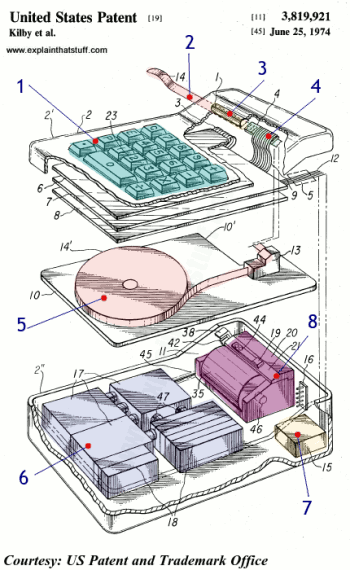
Artwork: Who invented the pocket calculator? Jack Kilby and colleagues at Texas Instruments in a patent filed in 1972 and granted two years later. Here's how it worked: (1) You typed your sums into the keyboard and watched the respond announced, shortly afterward, on a printed paper tape (in that location was no display) at the peak (2). A magnifying lens (3) helped you decipher the tiny numbers produced by the printer (four). Inside the example, we tin can encounter the newspaper record that feeds the printer (5). Beneath it, there's a huge bank of batteries (vi), a relatively tiny box full of electronics (vii), and the thermal printer mechanism (8). Find out more in U.s. Patent 3,819,921: Miniature electronic figurer. Artwork courtesy of United states Patent and Trademark Office (coloring and big numbers added for clarity).
Books
History
- The Departure Engine: Charles Babbage and the Quest to Build the Offset Reckoner by Doron Swade. New York: Viking, 2001. Tells the story of how calculators evolved into computers. Doron Swade ran the project to build Babbage's unfinished Deviation Engine at the British Science Museum and busts the myth that engineering limitations stopped Babbage from doing information technology himself.
Projects
- Make: Electronics by Charles Platt. Maker Media, 2015. "Experiment 20: Learning Logic" leads you through the basics of how logic gates work.
- Electronic Circuits for the Evil Genius: 64 Lessons with Projects by Dave Cutcher. McGraw Hill Professional, 2011. "Part 2: Introduction to Digital Electronics" is a good, hands-on guide to logic gates.
For younger readers
- The Maths Figurer Book DK, 2014. A hands-on introduction to using a calculator in classroom math for ages 7–11.
Articles
Full general
- This Classic Reckoner Was Literally Reverse Engineered From the Bare Metallic by Stephen Cass. IEEE Spectrum, May 22, 2020. How a replica of a Sinclair computer came into being.
- The Calculator That Helped State Men on the Moon by Elisabetta Mori. IEEE Spectrum, May 21, 2019. The story of the Olivetti Programma 101.
- The Surprising Story of the Outset Microprocessors by Ken Shirriff. IEEE Spectrum, August thirty, 2016. How the development of the microprocessor powered innovations like the first pocket calculators.
- Farewell, Pocket Calculator? by Alice Rawsthorn. The New York Times. March four, 2012. Now everyone carries a phone, does anyone even so demand a calculator? This article charts the slowly falling fortunes of pocket calculators from their 1970s heydey.
- For Texas Instruments, Computer Hackers Don't Add Upwards by David Kushner. IEEE Spectrum, 28 October 2009. Is information technology lawful to hack a calculator'southward operating system to get it to do more things?
- Blast From the Past by Kenneth R. Foster. IEEE Spectrum, 1 Oct 2007. Hewlett-Packard introduces a commemorative calculator to mark the 35th anniversary of its groundbreaking HP 35 figurer.
- How does a human being calculator do it?: BBC News, thirty July 2007. How do talented human mathematicians bear out uncommonly hard calculations in their heads?
History from the archives
- Those incredible new scientific pocket calculators by John Free. Popular Science, April 1974. This fascinating old article gives you a glimpse into how excited people were by programmable scientific calculators, which were the dwelling house computers of their twenty-four hour period.
- Shakeout Time for Calculators by Nathaniel Nash. The New York Times, Dec 8, 1974. The Times breathlessly informs us that "one out of ten Americans now owns" a estimator!
- Calculators on a chip are here! past John Gratis. Pop Science, March 1973. Remember when calculators used to fill up the windows of electronics stores?
Patents
- US Patent 3,819,921: Miniature electronic calculator by Jack Kilby, Jerry Merryman, and James Van Tassel, Texas Instruments, granted 25 June 1974. Kilby, who co-invented integrated circuits with Robert Noyce, also pioneered the handheld figurer. Here's his original patent. If you really desire to understand how calculators work, this is a swell identify to start.
Delight do Not copy our articles onto blogs and other websites
Articles from this website are registered at the US Copyright Office. Copying or otherwise using registered works without permission, removing this or other copyright notices, and/or infringing related rights could make you liable to astringent civil or criminal penalties.
Text copyright © Chris Woodford 2007, 2020. All rights reserved. Full copyright notice and terms of use.
Source: https://www.explainthatstuff.com/calculators.html
Belum ada Komentar untuk "Difference Between an Adding Machine and a Calculator Hit the Plus Again"
Posting Komentar